contentTracing
从Chromium收集追踪数据以找到性能瓶颈和慢操作。
Process: Main
此模块不包括 Web 界面。 若要查看记录的轨迹,请使用跟踪查看器,在Chrome上可以访问 chrome://tracking 。
[!NOTE] You should not use this module until the
readyevent of the app module is emitted.
const { app, contentTracing } = require('electron')

app.whenReady().then(() => {
  (async () => {
    await contentTracing.startRecording({
      included_categories: ['*']
    })
    console.log('Tracing started')
    await new Promise(resolve => setTimeout(resolve, 5000))
    const path = await contentTracing.stopRecording()
    console.log('追踪数据记录到: ' + path)
  })()
})
方法
contentTracing模块包含以下方法:
contentTracing.getCategories()
History
| Version(s) | Changes |
|---|---|
None | This method now returns a Promise instead of using a callback function. |
返回 Promise<string[]> - 一旦所有子进程都确认了 getCategories 请求,会 resolve 一个类别组的数组
获取一组类别组。 当到达新的代码路径时,类别组可能会更改。 See also the list of built-in tracing categories.
NOTE: Electron adds a non-default tracing category called
"electron". 此类别可以用于捕捉Electron特定的追踪事件。
contentTracing.startRecording(options)
History
| Version(s) | Changes |
|---|---|
None | The |
None | This function now returns a callback |
返回 Promise<void> - 当所有子进程都确认了 startRecording 请求后 resolve.
在所有进程上开始记录
一旦收到EnableRecording请求,记录立即在本地开始进行,并在子进程上异步执行。
如果一个记录已经运行了,promise将立即resolve,因为一次只能进行一个跟踪操作。
contentTracing.stopRecording([resultFilePath])
History
| Version(s) | Changes |
|---|---|
None | This method now returns a Promise instead of using a callback function. |
None | The |
resultFilePathstring (可选)
返回 Promise<string> - 一旦所有子进程都确认了 stopRecording 请求,会 resolve 一个包含了追踪数据的文件路径
停止所有进程记录。
子进程通常缓存跟踪数据,并且很少清空和发送跟踪数据回到主进程。 这有助于最小化运行时间开销,因为通过IPC发送跟踪数据可能是一个开销巨大的操作。 因此,为了结束跟踪,Chromium异步地要求所有子进程刷新所有挂起的跟踪数据。
追踪数据将被写入 resultFilePath。 如果 resultFilePath 是空的或未提供,追踪数据将被写入临时文件,并且路径将在promise中返回。
contentTracing.getTraceBufferUsage()
History
| Version(s) | Changes |
|---|---|
None | This method now returns a Promise instead of using a callback function. |
返回 Promise<Object> - resolve一个包含了追踪缓冲器的 value 和 percentage 最大使用量的对象
valuenumberpercentagenumber
获取追踪缓冲区在进程间的最大使用量(占全部状态的百分比)。
contentTracing.enableHeapProfiling([options]) 实验功能
History
| Version(s) | Changes |
|---|---|
None | API ADDED |
Returns Promise<void> - Resolves once heap profiling has been enabled.
Enable heap profiling for MemoryInfra traces. Equivalent to the --memlog switch in Chrome.
Only takes effect if the disabled-by-default-memory-infra category is included.
Needs to be called before contentTracing.startRecording().
用法:
const { contentTracing } = require('electron')

async function recordTrace () {
  await contentTracing.enableHeapProfiling()
  await contentTracing.startRecording({
    included_categories: ['disabled-by-default-memory-infra'],
    excluded_categories: ['*'],
    memory_dump_config: {
      triggers: [
        { mode: 'detailed', periodic_interval_ms: 1000 }
      ]
    }
  })

  await new Promise(resolve => setTimeout(resolve, 5000))

  const filePath = await contentTracing.stopRecording()
}
To view the recorded heap dumps:
-
Download the breakpad symbols for your Electron version from the Electron GitHub releases
-
Clone the Electron source code
-
In your Chromium checkout for Electron, run this command to symbolicate the heap dump:
python3 third_party/catapult/tracing/bin/symbolize_trace --use-breakpad-symbols --breakpad-symbols-directory /path/to/breakpad_symbols /path/to/trace.json -
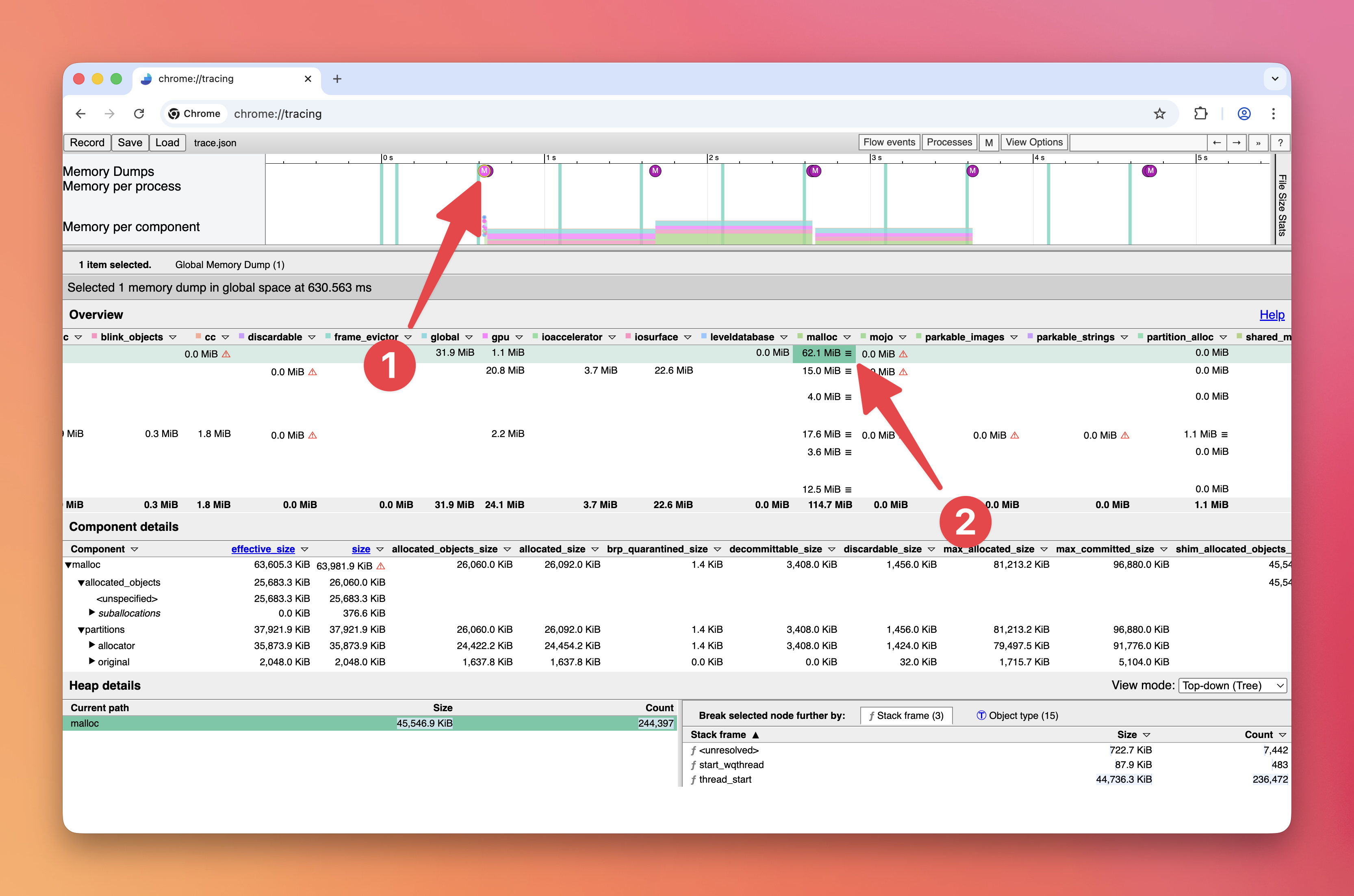
Open the symbolicated trace in
chrome://tracing(the Perfetto UI does not support memory dumps yet) -
Click on one of the
Msymbols -
Click on a
☰triple bar icon (e.g., in themalloccolumn)